
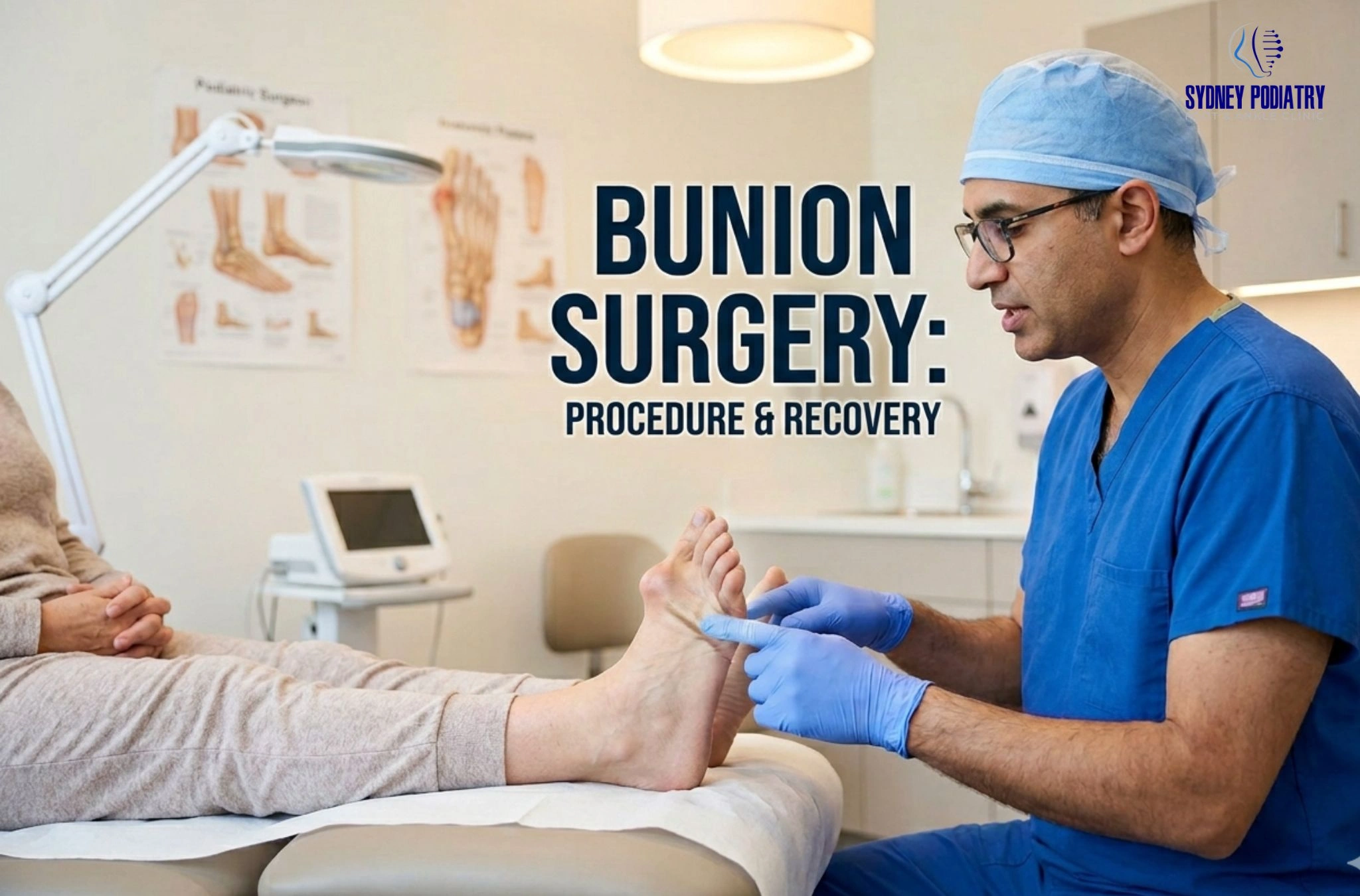
Quick Answer: Bunion surgery (bunionectomy) is a procedure to correct a painful bony deformity at the base of the big toe. You need it when non-surgical treatments have failed, daily walking becomes painful, and the deformity affects your quality of life.
This guide covers everything you need to know: what bunion surgery involves, the types available, signs you are ready for it, what the recovery actually looks like, and the risks worth considering before you book a consult.
What Is Bunion Surgery?
A bunion (hallux valgus) develops when the first metatarsal bone shifts outward and the big toe tilts inward, creating a bony protrusion on the inner foot. Left untreated, this misalignment worsens over time.
Bunion surgery, or bunionectomy, is a corrective procedure designed to realign the bone, joint, and soft tissues of the big toe. The aim is to relieve pain, restore alignment, and get you to move through daily life comfortably again.
Most bunion surgeries are performed as same-day procedures under local or general anaesthesia and take under an hour.
Types of Bunion Surgery
There are several types of bunion surgeries, and the right option depends on the severity, foot structure, and your overall health.
Here are the most common types:
1. Osteotomy
It is the most widely performed bunion surgery. The podiatric surgeon makes precise cuts in the metatarsal bone and repositions it to correct the alignment using small screws, pins, or plates. Osteotomy is typically recommended for mild to moderate bunions.
2. Exostectomy
A more limited procedure where the podiatric surgeon simply shaves down the bony bump. Because it does not correct the underlying misalignment, it is rarely done alone and is usually combined with an osteotomy. Exostectomy is only appropriate for very minor bunions.
3. Lapidus Procedure
In this type of bunion surgery, the podiatric surgeon realigns the foot by fusing the joint between the first metatarsal and the medial cuneiform bone closer to the midfoot. Lapidus is recommended for severe bunions or those with hypermobile joints. It provides strong, long-term correction and is also a preferred option for younger patients with significant deformity.
4. Arthrodesis (Joint Fusion)
Arthrodesis removes the big toe joint surfaces and fuses the bones together, eliminating painful movement at that joint. This is the most definitive correction for advanced cases. Recommended when the big toe joint is severely damaged, often due to arthritis.
5. Minimally Invasive Bunion Surgery (MIS/MICA)
It is a newer technique gaining significant traction. Small incisions of less than 1 cm are made, and specialised instruments are used to cut and reposition the bones with less tissue disruption. Patients typically heal faster, experience less swelling, and return to normal footwear sooner. MIS is best for mild to moderate bunions.
When Do You Need Bunion Surgery?
Surgery is usually the last resort after non-surgical treatments stop working. Consider speaking to your podiatrist about surgical options if you have:
- Persistent pain when walking, even in flat, wide-fitting shoes
- Chronic inflammation and swelling around the big toe that does not settle with rest or medication
- Difficulty bending or straightening the big toe
- A bunion interfering with daily activities, exercise, or work
- A bunion that is causing secondary issues like hammertoes or calluses
Remember: Bunions do not correct themselves. Without surgery, the alignment usually worsens over time. If symptoms continue despite conservative care, it may be worth discussing surgical options with your podiatrist.
The Bunion Surgery Procedure: What to Expect
Before Surgery
Your podiatric surgeon will review your medical history, take weight-bearing X-rays to assess the full extent of the deformity, and discuss the best surgical approach. You might also need to get an MRI or CT scan. You will be advised to stop certain medications beforehand.
During Surgery
Bunion surgery is typically performed under local anaesthesia with sedation or general anaesthesia.
An incision is made on the top or side of the big toe joint. Depending on the type of surgery, bone may be cut, repositioned, and secured with screws or plates. Soft tissues, tendons, and ligaments are then adjusted to support the new alignment. The wound is closed with sutures and dressed with a sterile bandage.
After Surgery
You will spend one to two hours in recovery before being discharged the same day. Your foot will be wrapped, and you will leave in a surgical boot or special post-operative shoe. Arrange transport in advance, as you will not be able to drive back home.
How long does it take to heal from bunion surgery?
Weeks 1–2
Rest, elevation, and minimal weight-bearing. You will be in a surgical boot. Pain and swelling are at their peak during this phase. Ice packs and prescribed pain relief help manage discomfort.
Weeks 3–6
You will begin transitioning to more weight-bearing activity. Wider, more comfortable shoes replace the surgical boot for many patients. Swelling continues but reduces progressively.
Weeks 6–12
Physical therapy starts at this stage to rebuild strength and improve toe joint movement. Most patients can manage daily activities with much independence.
3 to 6 Months
The majority of patients will be back to normal daily activities, and many will resume low-impact exercise. Footwear comfort improves significantly as the foot continues to settle.
Up to 12 Months
Complete bone healing and full resolution of swelling, particularly after complex procedures. Follow-up appointments with your podiatrist are recommended during this period.
One important note: minimally invasive surgery generally results in faster recovery than traditional open procedures.
Risks and Complications of Bunion Surgery
Bunion surgery is a safe and well-established procedure, but like any surgery, there are risks.
- Potential complications include:
- Infection at the surgical site
- Delayed bone healing or non-union of fused joints
- Nerve damage, resulting in numbness, tingling, or hypersensitivity
- Recurrence of the bunion (especially without changing footwear habits)
- Stiffness or reduced range of motion in the big toe
- Swelling that persists for several months
- In rare cases, removal of painful or prominent hardware (screws/plates)
Serious complications are rare when bunion surgery is performed by a foot and ankle specialist and post-operative instructions are followed. Your surgeon will explain any specific risks before surgery.
Take the First Step Towards Pain-Free Walking
If bunion pain is holding you back, our team at Sydney Podiatry is here to help. From conservative management through to surgical referral and post-operative care, we offer expert foot and ankle care at our Double Bay and Drummoyne clinics.
Book your appointment today and explore the best treatment options for your feet.
